Organ-on-a-Chip Microfluidic System
Changing the landscape of drug discovery
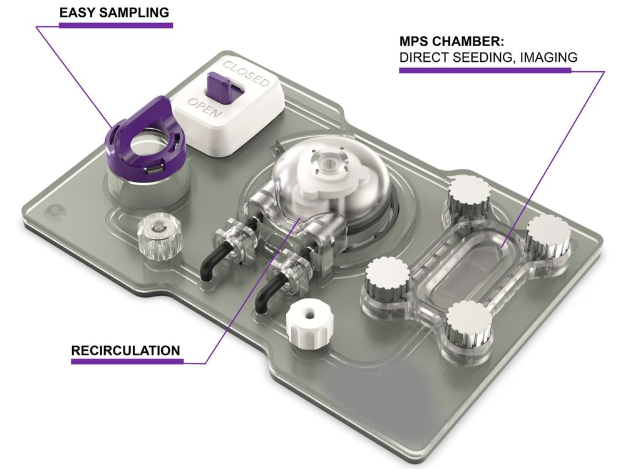
At Fikst, I led the design, validation and manufacturing of a novel lab-on-a-chip device, integrating multidisciplinary insights into a manufacturable microfluidic platform and delivering results to our client with technical precision.
- Microfluidics
- Polymer Bonding
- CFD
- Experimental Design
Challenge
Drug discovery relies heavily on animal testing which often does not accurately represent human physiology, leading to wasted resources and misleading results. By creating a microphysiological system with human cells, we can test drugs in the biological environment they are intended to be used in and at a lowest cost than animal testing.
Approach
Working closely with biologists, I identified key limitations in existing cell culture platforms used for drug testing. A review of recent research revealed that cells maintained in static culture often fail to replicate their natural physiological state. These findings informed the development of a culture system designed to better reproduce the environmental conditions required to maintain native cellular morphology.
Engineering Decisions
I integrated multidisciplinary insights to inform material selection, surface modification, and channel geometry into a single coherent design, balancing fluidic performance against biological sustainability.
Prototyping Process
My first objective was not perfection, it was learning. I rapidly developed a prototype capable of sustaining cell viability so the biology team could begin refining their culture process while the cartridge design continued to evolve. Using in-house CNC machining and a heat-press-compatible diffusion bonding method, I was able to produce functional prototypes quickly and support rapid design iteration.
Manufacturing Considerations
As our clients experimental capacity increased, I redesigned the cartridge to enable injection molded parts and a laser welding assembly process to increase our fabrication throughput without the need for new facilities or increased staffing.
Results
Device and process performance increased up until product launch. Surface modification led to a 5x decrease in seeding time and insight from CFD models informed oxygenation and seeding chamber geometries to keep cells in a stable, physiologically accurate state. Ultimately our device kept harvested human cells alive in a confluent monolayer for longer than any system recorded in scientific literature.
- Novel device platform
- Organ-on-a-chip
- Insights integrated
- Multidisciplinary
- Pushed forward
- Scientific Boundary
Next project
Electroporation Device