Product design, process development, and automation
Three pillars that span the product development lifecycle, from defining the problem to scaling production.
Pillar 01
Product Design
Decoding the real engineering problem behind the unmet need and turning it into a design that can be built.
Skills
- CAD
- CAM
- GD&T
- DFM
- DFA
- CFD
- CNC Machining
- 3D Printing
- Laser Cutting
- Silicone Molding
- Material Selection
- Polymer Bonding
- Thin Films
- Surface Modification
Problem Definition
Decoding the real engineering problem behind the unmet need.
- Stakeholder and client interviews
- Constraint and risk mapping
- Define measurable success criteria
I've worked with nearly a dozen biotech startups and academic research labs to define and solve their hardest engineering problems. I'm comfortable sitting down with scientists and founders, cutting through ambiguity, and turning a vague scientific need into a clear, measurable problem statement before any design work begins.
Research & Requirements
Translate biology, physics, and user needs into quantified requirements.
- Literature & prior-art review
- Requirements discovery
- Benchmarking & feasibility studies
I come from a research background. At Boston University I processed silicon wafers into microfluidic chips and characterized them with optical and electron microscopy — work that contributed to a peer-reviewed publication in Nanoscale. I'm at home reading the literature and translating biology and physics into quantified requirements.
Read the paper — Nanoscale (DOI: 10.1039/C9NR08476B)Concept Generation
Compartmentalizing a problem to understand what approach is most likely to work
- Ideation & sketching
- Concept scoring matrices
- Development path selection
I decompose the problem into its fundamental physical, biological, and operational requirements before considering solutions. From there, I generate multiple concepts that satisfy the core constraints through different engineering approaches.
Simulation & Analysis
Gain critical insights at a fraction of cost and time of experimentation.
- CFD & multiphysics modeling
- Physiological Modeling
- Tolerance stack-up & GD&T
I use CFD and multiphysics modeling to understand system behavior before cutting material, and I run tolerance stack-ups with GD&T so I know where the design margin is. Simulation lets me kill bad ideas cheaply and reduce the prototyping burden.
Rapid Prototyping
Build to learn fast with in-house fabrication and quick turns.
- CNC machining & 3D printing
- Laser cutting & silicone molding
- Embedded electronics integration
I prototype in-house and fast. Between machining, 3D printing, laser cutting, and silicone molding, I can usually go from CAD to a part in my hands the same day and build to learn instead of guessing.
Design for Manufacturing
Re-engineer the design so it can be built repeatably and at cost.
- DFM/DFA reviews
- Material & process selection
- Cost-down analysis
I excel at design for manufacturing because I've actually made the parts. I've produced components with nearly every conventional manufacturing technique, so when I design I already know how it will be built and I design with those real process constraints baked in rather than discovering them later.
Pillar 02
Process Development
Measure, learn, and iterate until the product can be built repeatably, proven, and transferred to production.
Skills
- Experimental Design
- Data Analysis
- Injection Molding
- Cleanroom Processing
- GMP
- Cell Culture
- Electroporation
- Sterilization
- Vendor Management
- Procedure Creation
Testing & Iteration
Measure, learn, and iterate against the requirements.
- Experimental design (DOE)
- Data acquisition & analysis
- Failure investigation
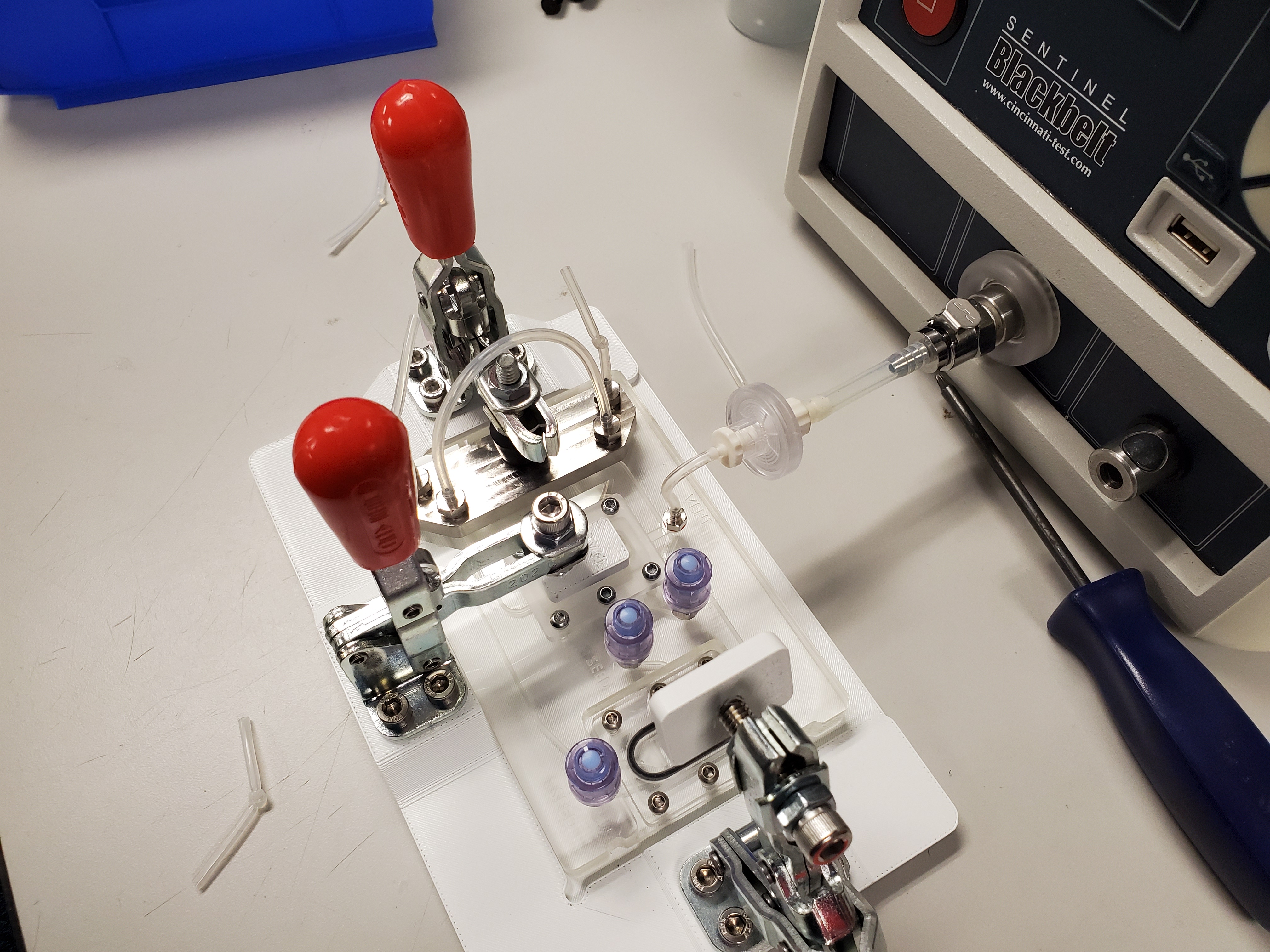
I design experiments and build instrumented test setups to measure performance objectively, like this leak testing fixture I built to ensure cartridge seals functioned properly. I let the data drive each iteration and dig into failures until I understand the root cause.
Verification & Validation
Prove the product meets requirements and intended use.
- V&V protocol execution
- Design verification testing
- GMP / cleanroom documentation
I execute verification and validation protocols and the metrology behind them. I'm comfortable generating the documentation and traceability needed to prove a product meets its requirements and intended use.
Product Launch
Transfer to production and support the first builds in the field.
- Production transfer
- First-article inspection
- Packaging & QC documentation
I take designs across the finish line into production with released documentation, first-article inspections, and the packaging and QC records that travel with a launched product, like the inspected, foam-packaged cartridge shown here. I stay involved to support the first builds in the field.
Pillar 03
Automation
Performing Equipment FAT/SAT, developing processes, and creating sustainable operation plans.
Skills
- Equipment Integration
- FAT/SAT
- MES
- Dashboards
- Laser Welding
- Machine Vision
- Embedded Software
- Assembly Process Design
- Technician Training
- AI Tools
Related projects
Process & Scale-Up
Performing Equipment FAT/SAT, developing processes, and creating sustainable operation plans.
- Assembly process design
- Equipment integration
- Technician training
I develop the assembly processes, fixtures, and work instructions that turn a prototype into something a team can build repeatably — like the full set of cartridge components shown here, ready for assembly. I also train technicians directly so the process runs consistently no matter who is on the bench.
Data Collection & Analysis
Capture critical process data and turn it into decisions.
- MES data retention
- Live dashboards
- AI-assisted analysis
I use MES to retain critical process data, which feeds dashboards that give instant sitreps on how the line is running. I use AI-developed tools to analyze that data in a way that exposes the fundamentals of an application and informs leaders on how to improve our systems.